
A private key stored in a software vault is still a file on a disk. Encrypt it, wrap it, split it across shares, and it remains a sequence of bytes that lives in the same memory space as the application that uses it. Anyone with root access, a kernel exploit, or a well-timed memory dump has a shot at it. A hardware security module removes that bet from the table by keeping the key inside a physical boundary that never exposes the raw material, even to the system administrators who manage it.
That distinction matters more in fintech than almost anywhere else. The keys in question sign payment authorizations, decrypt cardholder data, generate the tokens that stand in for account numbers, and anchor the trust chain that regulators and card networks require you to prove. If that root of trust is software, your entire control framework rests on an assumption that a disk image can’t be copied. If it’s an HSM, the key material never leaves tamper-resistant hardware, and any attempt to extract it triggers zeroization: the module destroys its own keys rather than let them be read.
What a hardware security module actually secures that software key storage can’t
An HSM is a dedicated computing device built to generate, store, and use cryptographic keys without ever exposing them in plaintext outside its physical boundary. Operations like signing, encryption, and key derivation happen inside the module. The application sends a request and gets back a result; it never touches the key itself.

The protection that matters here is physical, not just logical. Certified HSMs include tamper-detection circuitry: sensors for voltage changes, temperature extremes, drilling, and chassis intrusion. Trip one of those sensors and the module erases its keys automatically. Software key management, even with strong encryption at rest, can’t replicate that. A software key is still readable by a sufficiently privileged process; a key inside a certified HSM is not extractable by any process at all.
For a fintech institution, this isn’t an abstract security upgrade. It’s the difference between a key management posture you can describe in an audit as “confidential” and one you can describe as “unextractable.” Regulators, card networks, and auditors treat those as different claims, and PCI DSS requirements around cryptographic key management increasingly expect the second one for keys that protect cardholder data or signing operations.
Network attached, PCIe card, and cloud HSM: matching deployment to your architecture
HSMs come in three deployment shapes, and the right one depends on how your transaction volume, latency tolerance, and infrastructure are organized rather than on which vendor pitches the hardest.
Network-attached HSMs sit in your data center as standalone appliances, accessed over the network by multiple applications and servers. They centralize key operations for an entire payment stack, which simplifies key management and auditing but introduces network latency on every cryptographic call. This model suits institutions running multiple applications that all need access to a shared pool of keys, such as a core banking platform alongside a card issuing system.
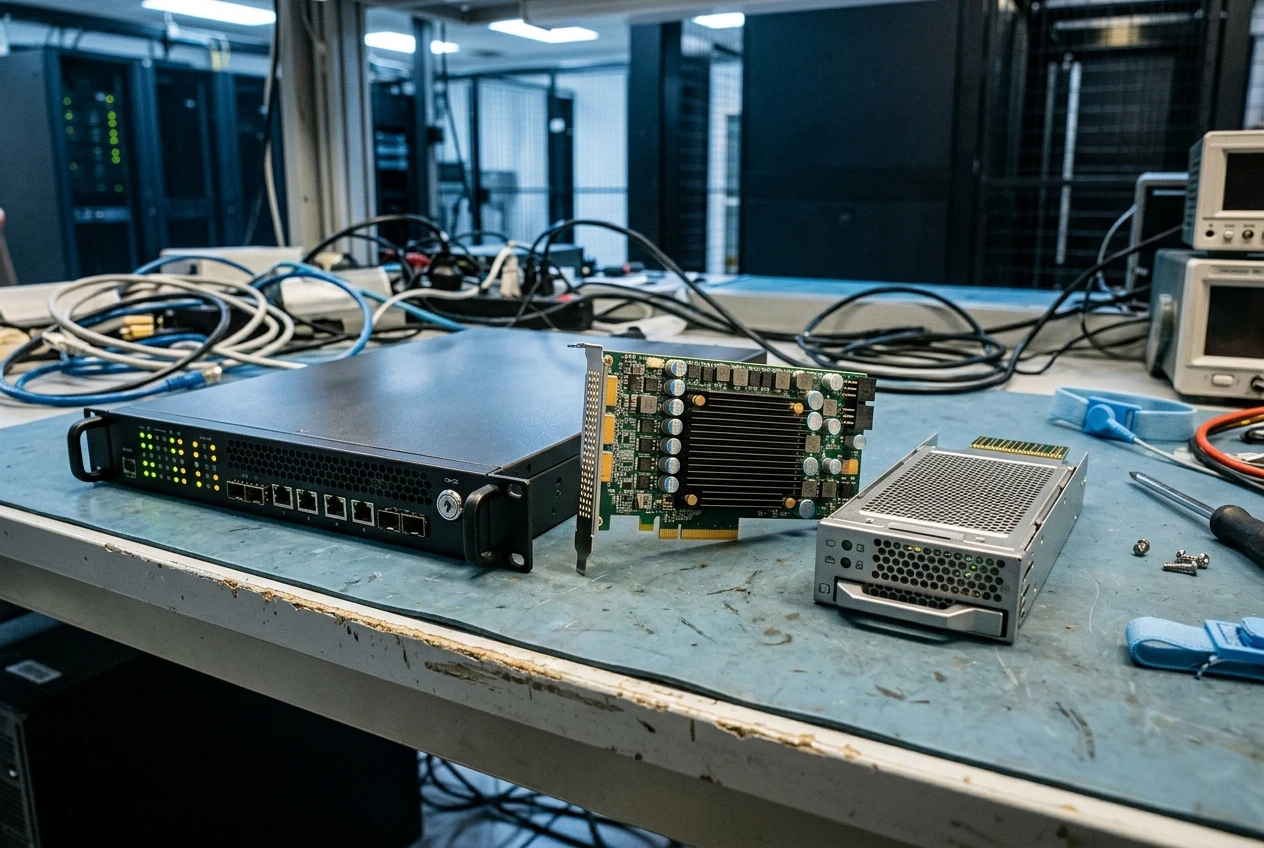
PCIe card HSMs install directly into a server’s expansion slot, putting the cryptographic boundary a few centimeters from the CPU instead of across a network hop. Latency drops accordingly, which matters for high-throughput signing operations like real-time payment authorization. The tradeoff is that the HSM is now tied to a single physical server, so scaling means adding cards rather than pointing more traffic at a shared appliance.
Cloud HSM services let you provision dedicated, single-tenant HSM hardware inside a cloud provider’s data center, managed through an API rather than a rack you visit. They remove the capital cost and the physical maintenance burden, and they scale in line with the rest of a cloud-native fintech stack. The tradeoff is that you’re trusting the provider’s attestations about physical isolation, and your key ceremony procedures need to account for an operator you don’t control the building for.
None of these is categorically “best.” A payments processor running its own data center with steady, predictable transaction volume often does better with network-attached or PCIe hardware. A fintech built cloud-native from day one, with the kind of elastic infrastructure described in the best cloud providers for financial data security, usually gets more value from a cloud HSM that scales alongside the rest of its stack.
Reading FIPS 140-3 and PCI HSM certifications without getting fooled by marketing language
Certification language in HSM marketing is dense, and vendors lean on that density. Two certifications matter for fintech buyers, and they’re not interchangeable.
FIPS 140-3 is a US government standard, issued by NIST, that defines security requirements for cryptographic modules across four levels. Level 1 covers basic software-based cryptography with no physical security requirements. Level 2 adds tamper-evidence. Level 3 requires tamper-detection and response, identity-based authentication, and physical separation between interfaces that handle critical security parameters. Level 4 adds protection against environmental attacks like voltage and temperature manipulation. For fintech key management, Level 3 is generally the floor worth asking about, and Level 4 is relevant for issuers handling the highest-value signing keys.
Watch for a specific bit of marketing sleight of hand here: a vendor can claim “FIPS 140-3 validated” when only one configuration or sub-component of their product line holds the certificate, while the appliance you’d actually buy ships with different firmware or a different default mode. Ask for the exact certificate number and check it against NIST’s own validation list. A certificate number that doesn’t match the specific model and firmware version you’re quoted is not a validation.
PCI HSM is a separate certification administered by the PCI Security Standards Council, specifically for devices used in payment card processing. It covers requirements FIPS doesn’t, including secure key injection, PIN block translation, and protections specific to payment transaction flows. A module can be FIPS 140-3 validated without being PCI HSM approved, and if your workload touches cardholder data or PIN processing, PCI HSM approval is the certification that actually governs your compliance posture, not FIPS alone.
The practical move: ask vendors for the certification document itself, not a summary slide, and check the expiration and scope. Certifications lapse, and a module validated three years ago under an earlier revision may not satisfy a current audit requirement.
Key ceremonies and dual control: the operational discipline an HSM forces on you
Buying an HSM doesn’t just change your hardware. It changes your operating procedures, and the change is deliberate.
A key ceremony is the formal, scripted process of generating, backing up, or loading a root cryptographic key into an HSM. It’s typically performed with multiple authorized participants present, each holding a physical component (a smart card or key share) required to reconstruct or authorize the operation. No single person can complete the ceremony alone. That’s the point.

Dual control means no critical cryptographic operation can be performed by one individual acting alone. Key generation, key export, and administrative changes to the HSM’s configuration require two or more authorized people, often from different departments, to authenticate together. Split knowledge goes further: the key material itself is divided into components, and no single component reveals anything about the complete key.
These aren’t bureaucratic overhead. They exist because the single greatest risk to a well-designed cryptographic system is an insider with legitimate access and bad intent, or a legitimate administrator whose credentials get compromised. A software key vault can enforce access control, but a determined insider with admin rights can usually find a way around it. An HSM that requires two physical key-holders in the room to authorize a root key ceremony removes that single point of failure structurally, not just procedurally.
If your institution doesn’t yet have documented key ceremony procedures, build them before the HSM arrives, not after. Define who holds which key component, how often ceremonies occur, what gets logged, and what the recovery procedure looks like if a key custodian leaves the organization. An HSM vendor can advise on ceremony structure, but the governance decisions belong to you.
Where HSMs fit in payment processing, tokenization, and digital signing workflows
In a payment processing stack, HSMs typically sit at a small number of specific points rather than being woven through the entire flow.
- PIN processing and verification: HSMs decrypt and translate PIN blocks during card transactions, a function that PCI HSM certification specifically addresses.
- Tokenization: when a card number is replaced with a token for storage or transmission, the cryptographic operation generating that mapping often runs inside an HSM, particularly where the tokenization scheme is reversible and the detokenization key needs hardware protection.
- Digital signing: transaction authorization messages, certificate issuance for mutual TLS between financial institutions, and code-signing for software updates to payment infrastructure all rely on signing keys that benefit from HSM-backed protection.
- Key wrapping for data encryption: HSMs often hold the master keys that encrypt (wrap) data encryption keys used elsewhere in the stack, so a compromise of application-layer storage doesn’t expose the keys that protect data at rest.
This is distinct from application-layer security controls like input validation, session management, and API authentication, which matter for a different set of threats. If you’ve already worked through the layers that actually matter for fintech application security, think of the HSM as the layer beneath all of that: it protects the keys those application controls depend on, rather than the application logic itself.
Integrating an HSM into an existing stack without a six month migration
The long integration timelines that give HSM projects a bad reputation usually come from one mistake: trying to migrate every key and every application simultaneously.
A narrower approach works better. Start with the highest-value keys, the ones protecting PIN processing or root signing certificates, and move only those into the HSM first, through a key ceremony that establishes clean provenance from day one. Leave lower-sensitivity keys in their existing storage until the first migration is validated in production.
Most HSM vendors support standard interfaces, PKCS #11, Microsoft CNG, and Java’s JCE/JCA, which means applications already using those standard cryptographic APIs can often point to the HSM with configuration changes rather than code rewrites. Where an application does custom key handling outside these standards, that’s where real engineering time goes, and it’s worth scoping that work before committing to a timeline with stakeholders.
Run the HSM in parallel with existing key storage during a defined cutover window, with monitoring on both paths, before decommissioning the old system. That overlap period is where integration problems surface safely instead of during a live incident.
Cloud HSM versus on premises: cost and control tradeoffs for institutional fintech
On-premises HSMs carry upfront capital cost, physical installation and maintenance overhead, and staff time for firmware updates and health monitoring. In exchange, you get full physical control: you know exactly which building the hardware sits in, who has badge access, and how the tamper-detection circuitry is configured.

Cloud HSM services shift that cost to an operating expense, billed per hour or per key operation, and remove the physical maintenance burden entirely. The scaling benefit is real: provisioning additional HSM capacity for a transaction volume spike takes an API call rather than a hardware order. The tradeoff is that your institution’s compliance posture now depends partly on the cloud provider’s own certifications and attestations, which your auditors will want to see directly rather than take on faith.
For institutional fintech handling regulated payment data, a hybrid model is common: on-premises or PCIe HSMs for the highest-sensitivity root keys and PIN processing, cloud HSM for workloads that scale elastically and don’t carry the same regulatory weight. The decision maps closely to the broader cloud architecture choices described in how cloud architecture lets fintechs scale without breaking financial-grade reliability, where the same control-versus-elasticity tradeoff shows up at the infrastructure layer generally.
A buyer’s checklist before you request a vendor quote
Before any vendor conversation, have answers ready for:
- Which specific workloads need HSM protection: PIN processing, tokenization, signing, key wrapping, or a combination.
- What certification level you actually need: FIPS 140-3 Level 3 as a floor, PCI HSM approval if cardholder data or PIN processing is in scope.
- Which deployment model fits your transaction volume and latency requirements: network-attached, PCIe, or cloud.
- Whether your organization has documented key ceremony and dual control procedures, or whether those need to be built alongside the deployment.
- What your integration surface looks like: which applications use standard cryptographic APIs versus custom key handling.
- What your disaster recovery and key backup procedure looks like, including how a lost or compromised key custodian is handled.
- What the total cost looks like across hardware or service fees, integration engineering time, and ongoing key ceremony operations, not just the sticker price on the module itself.
A vendor’s sales team will answer confidently on all of these. Confirming those answers against documentation is a separate exercise. Before you sign with an HSM vendor, run them through the vetting framework in how to vet a fintech vendor before you sign to confirm their compliance claims hold up under scrutiny.