
A transaction monitoring system built on fixed thresholds will flag a $9,800 wire the same way every time: by comparing it to a number. That is precisely why a launderer who knows the threshold is $10,000 sends $9,800. The rule did its job and still missed the point, because the rule was never watching behavior. It was watching a single number against another single number, and sophisticated laundering is built to pass exactly that test.
This is the gap that AI anti-money laundering detection is meant to close. Not by replacing the rulebook, but by watching the patterns around a transaction rather than the transaction alone: who sent it, what account received it, what else that account has done in the last ninety days, and how that whole cluster of activity compares to the millions of legitimate transactions moving through the same rails. For compliance officers building or buying monitoring systems, the real question isn’t whether machine learning can spot money laundering. It’s whether the output can survive a regulator’s question of “how do you know,” which is a very different bar than catching the pattern in the first place.

Why rule-based thresholds keep missing sophisticated laundering
Static rules work on known shapes. A rule can catch a transaction over $10,000, a wire to a sanctioned country, or a cash deposit followed by an immediate transfer. Each of those is a fixed condition, checked in isolation, and each one is public knowledge to anyone who has read a compliance manual or worked inside a bank.
That transparency is the weakness. Launderers adjust to known thresholds the same way a driver adjusts to a speed camera: not by driving honestly, but by driving exactly at the limit. A network built around a $10,000 reporting threshold doesn’t send $10,000. It sends nine transactions of $1,100 through nine different accounts over two weeks. No single transaction trips anything. The rule set stays green while the money moves.
Rules also treat every transaction as independent of every other. A $5,000 transfer from Account A to Account B looks the same to a threshold engine whether it’s one transfer among thousands that account makes, or the fortieth transfer this month in a chain that started at a cash business and will end at an account in a different jurisdiction three hops later. The rule has no memory of the chain, because it was never built to hold one.
The laundering patterns that break static rules: structuring, layering, mule networks
Three typologies account for most of what slips past threshold-based monitoring, and each one exploits a different blind spot.

Structuring breaks a large sum into smaller transactions, each one under the reporting threshold, spread across accounts, time, or both. The individual transactions are unremarkable. The pattern only becomes visible when you look at the aggregate across a window of days or weeks, which a rule checking transaction-by-transaction never does.
Layering moves funds through a chain of accounts, shell entities, or jurisdictions specifically to separate the money from its origin. Each hop can look legitimate on its own; a transfer to a registered business, a payment for consulting services, a currency conversion. The laundering is in the chain, not in any single link, and a system that evaluates links one at a time has no way to see the chain.
Mule networks use real people, often recruited through job scams or romance schemes, to receive and forward funds through legitimate-looking personal accounts. These accounts pass every individual KYC check because the people behind them are real. What gives them away isn’t identity, it’s behavior: an account that suddenly receives several deposits from unrelated senders and forwards the funds out within hours, a pattern that has nothing to do with how that person has used the account for the previous two years.
All three typologies share a structure: the giveaway is in the relationship between transactions, not in any transaction’s individual attributes. That’s a shape rule-based systems are not built to see.
How machine learning models learn what normal money movement looks like
A behavioral model doesn’t start by looking for laundering. It starts by learning what normal looks like for a given account, a given customer segment, or a given corridor of money movement, and then it flags deviation from that baseline.
For an individual account, normal might mean a fairly stable pattern of inflows and outflows, a consistent set of counterparties, and transaction sizes that cluster in a predictable range. For a small business account, normal looks different again: seasonal spikes, a wider range of counterparties, irregular timing tied to invoicing cycles. The model builds a baseline for each profile rather than applying one threshold to everyone, which is already an improvement on a rule that treats a student’s checking account and a logistics company’s operating account the same way.
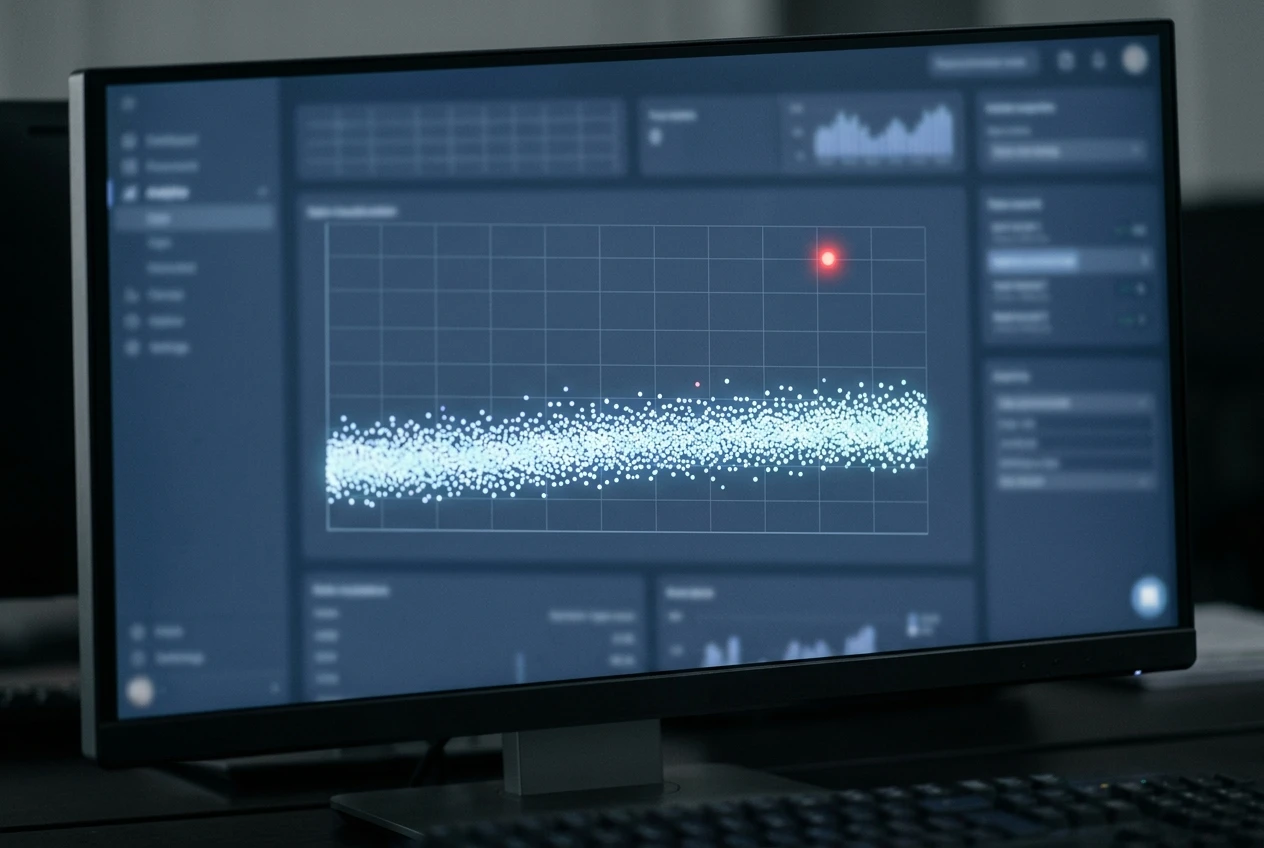
Once that baseline exists, the model can score new activity against it. A sudden shift in counterparty patterns, a transaction size well outside the account’s normal range, or a change in the timing and frequency of transfers all raise the account’s risk score, even when no single transaction crosses any fixed number. This is also where structuring gets caught: the model isn’t looking at each $1,100 transfer, it’s looking at the fact that this account, which normally sends one or two transfers a month, suddenly sent nine in two weeks to nine different recipients it has never dealt with before.
The tradeoff is that these models need a reasonable volume of history to build an accurate baseline, and they need ongoing retraining as legitimate customer behavior shifts over time. A model trained on pre-pandemic spending patterns, for instance, would have flagged an enormous share of normal customers as anomalous the moment behavior changed at scale. Baselines drift, and the model has to drift with them or it starts generating noise instead of signal.
Network and graph analysis: catching mule accounts and shell layering that isolated transactions hide
Behavioral scoring looks at one account’s history. Graph analysis looks at the relationships between accounts, and that’s where mule networks and layering chains actually become visible.
In a graph model, accounts are nodes and transactions are edges connecting them. The model isn’t asking whether one account’s activity looks unusual, it’s asking whether the shape of the network around that account looks unusual. A cluster of accounts that have no obvious connection to each other, opened around the same time, that suddenly start passing money between them in a pattern that converges on a single exit point, is a shape a graph model can surface even when every individual account passes its own behavioral check.

This is precisely how mule networks get caught in practice. A mule account might look completely normal on its own: steady balance, regular small transactions, nothing that trips a behavioral anomaly score. What gives it away is its position in a graph: it receives deposits from several accounts that have no other connection to each other, and it forwards nearly all of that money out within a short window. No single transaction is suspicious. The network position is.
Shell company layering works the same way from the institutional side. A chain of shell entities might each file clean paperwork and pass individual due diligence, but a graph model can surface that the same handful of directors, addresses, or registered agents keep appearing across entities that are supposedly unrelated, and that money flows through that cluster in one direction before exiting to a jurisdiction with weak reporting requirements. That’s a pattern that isolated transaction review, or even strong behavioral scoring, is not built to find, because it only shows up when you connect accounts across the network rather than evaluating them one at a time.
What adaptive models actually do to alert fatigue and false positive rates
Rule-based systems are notorious for generating a flood of alerts, the overwhelming majority of which turn out to be legitimate activity that happened to brush against a threshold. Analysts spend most of their time clearing noise, and the real cases get buried in volume. That’s not a hypothetical problem in most compliance shops; it’s the daily reality of the queue.
Adaptive models reduce that volume by scoring risk rather than applying binary thresholds, which means alerts can be ranked by severity instead of treated as equally urgent. An account with a mild deviation from baseline and no suspicious network position can sit lower in the queue than one with both a behavioral anomaly and a graph position matching a known mule pattern. That ranking lets analysts spend their time where the risk is actually concentrated.
The honest caveat is that adaptive models don’t eliminate false positives, they shift the error profile. A poorly tuned model can still generate plenty of noise, particularly early in deployment before it has learned enough about the customer base to set accurate baselines. The gain isn’t a magic drop to zero false positives, it’s a shift toward alerts that carry more information per alert, which is what actually reduces analyst fatigue over time.
The explainability problem: making an AI flag defensible in a SAR
A rule-based alert explains itself: the transaction exceeded $10,000, or matched a sanctioned entity list. A machine learning alert, especially one built on a graph model, scores risk based on dozens of weighted factors interacting with each other, and that score doesn’t translate directly into a sentence a regulator can read.

This matters because a Suspicious Activity Report has to state a basis for suspicion, and “the model’s risk score exceeded 0.87” is not a basis a regulator will accept on its own. A defensible SAR needs the underlying factors stated in plain terms: unusual counterparty concentration, a transaction pattern inconsistent with account history, a network position matching known mule behavior. Compliance teams deploying these models need the system to surface those contributing factors alongside the score, not just the score itself, and they need an analyst in the loop who reviews and documents the reasoning before it goes into a filing.
This is also why explainability has become a procurement question, not just a technical one. A vendor whose model can’t show its work in terms an analyst can turn into a SAR narrative is building a tool the compliance team can’t actually use when it matters.
What regulators expect from an AI-driven AML program today
Regulators are not asking institutions to stop using machine learning, but they are asking for documented model governance: how the model was trained, how it’s validated, how often it’s retrained, and how false negatives are tracked and reviewed. They expect a human decision point before a SAR is filed, not an automated filing pipeline. And they expect the institution to be able to explain, in plain language, why a specific alert was raised, which pushes model selection toward systems built for transparency rather than raw predictive power alone.
The practical upshot for teams building or buying these systems is that the AI does the surfacing, and the compliance program still does the deciding and the documenting. Getting that division right is less a machine learning problem than a program design problem, and it sits on top of the broader compliance groundwork most fintechs have to get right regardless of which detection technology they choose. For that groundwork, see a founder’s roadmap to fintech compliance and why automated compliance became the fintech standard.